
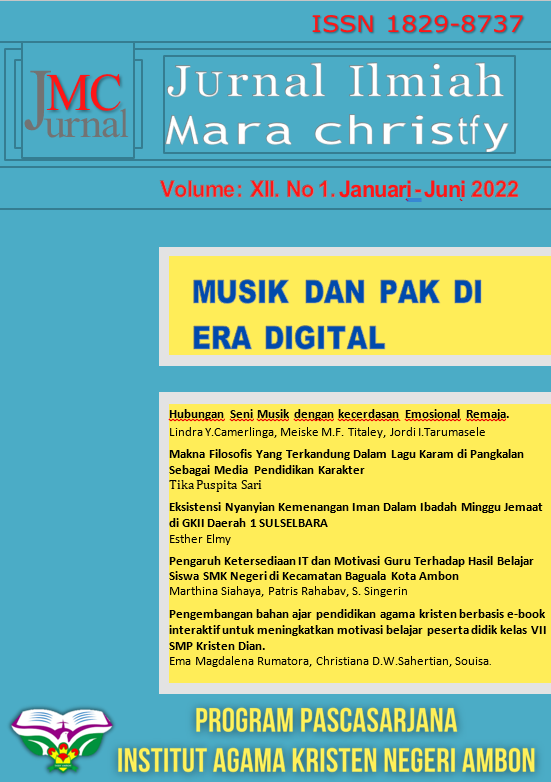
The philosophical meaning contained in the song Karam di Pangkalan is a medium for character education
DOI:
https://doi.org/10.37196/mc.v12i1.113Keywords:
Philosophical, meaning, Character Education, ValuesAbstract
This research aims to explore the content of the song "Karam di Pangkalan," focusing on the character education values imparted to the teenagers of Muara Enim. Employing a qualitative design, the research utilized documentation as the primary data collection technique. The subsequent data analysis employed text content analysis through descriptive methods, following the semiotic approach of Roland Barthes. The investigation revealed significant character education values embedded in the traditional song "Karam di Pangkalan," which holds cultural significance for the Muara Enim community. The identified character values include religiosity, honesty, tolerance, discipline, diligence, creativity, democracy, curiosity, and responsibility. The qualitative design allowed for a nuanced examination of the song's content, unveiling the underlying values that contribute to the character education of Muara Enim's teenagers. By employing text content analysis and a semiotic approach, the research not only identified these character values but also delved into the intricate layers of meaning within the song's lyrics. This study contributes to understanding how traditional songs can serve as a medium for instilling character education values within a community, shedding light on the cultural and educational dimensions inherent in such musical expressions.
References
S. Sularso, “Studi Pendidikan Musik di Indonesia: Strategi Merawat Lokalitas Melalui Pembentukan Agen Kreatif di Sekolah Dasar,” J. JPSD (Jurnal Pendidik. Sekol. Dasar), vol. 6, no. 1, pp. 35–39, 2019.
P. Lestari and S. Sularso, “The COVID-19 impact crisis communication model using gending Jawa local wisdom,” Int. J. Commun. Soc., vol. 2, no. 1, pp. 47–57, Jun. 2020, doi: 10.31763/ijcs.v2i1.150.
L. Listyaningsih, S. Alrianingrum, and S. Sumarno, “Preparing Independent Golden Millennial Generation Through Character Education,” in 2nd Annual Conference on Education and Social Science (ACCESS 2020), 2021, pp. 162–167, doi: 10.2991/assehr.k.210525.066.
S. Hamdi, R. Setiawan, and F. Musyadad, “Evaluation of the implementation of Indonesia Pintar program in vocational school,” J. Penelit. dan Eval. Pendidik., vol. 24, no. 1, pp. 102–115, Aug. 2020, doi: 10.21831/pep.v24i1.32603.
M. Masing and K. Astuti, “Dropping Out of the School: Factors and Its Impact On Primary School In Indonesia,” Psychosophia J. Psychol. Relig. Humanit., vol. 4, no. 1, pp. 10–18, Apr. 2022, doi: 10.32923/psc.v4i1.1850.
M. G. Pratt, S. Sonenshein, and M. S. Feldman, “Moving Beyond Templates: A Bricolage Approach to Conducting Trustworthy Qualitative Research,” Organ. Res. Methods, vol. 25, no. 2, pp. 211–238, Apr. 2022, doi: 10.1177/1094428120927466.
G. Allen, Roland Barthes. Routledge, 2004. doi: 10.4324/9780203634424
C. Morris, “Signs About Signs About Signs,” Philos. Phenomenol. Res., vol. 9, no. 1, pp. 115–133, Sep. 1948, doi: 10.2307/2103856.
S. Zhang, “Meaning-Centrism in Roland Barthes’ Structuralism,” Chinese Semiot. Stud., vol. 13, no. 3, pp. 219–227, Aug. 2017, doi: 10.1515/css-2017-0012.
R. Barthes and L. Duisit, “An Introduction to the Structural Analysis of Narrative,” New Lit. Hist., vol. 6, no. 2, pp. 237–272, Jan. 1975, doi: 10.2307/468419.
C. C. Lemert, “The Social Structure of Meanings: Ferdinand de Saussure and the Arbitrary Sign,” in Thinking the Unthinkable, Routledge, 2015, pp. 147–163. doi: 10.4324/9781315631578
S. H. Heriwati and S. Sularso, “Lagu menghubungkan masa lalu dengan masa kini: Analisis sosiolinguistik pertunjukan Didi Kempot,” Kawruh J. Lang. Educ. Lit. Local Cult., vol. 4, no. 2, pp. 76–84, Oct. 2022, doi: 10.32585/kawruh.v4i2.2835.
M. S. Schomaker and S. Zaheer, “The Role of Language in Knowledge Transfer to Geographically Dispersed Manufacturing Operations,” J. Int. Manag., vol. 20, no. 1, pp. 55–72, Mar. 2014, doi: 10.1016/j.intman.2013.10.004.
D. Governor, J. Hall, and D. Jackson, “Teaching and Learning Science Through Song: Exploring the experiences of students and teachers,” Int. J. Sci. Educ., vol. 35, no. 18, pp. 3117–3140, Dec. 2013, doi: 10.1080/09500693.2012.690542.
S. O. Ali and Z. F. Peynircio?lu, “Songs and emotions: are lyrics and melodies equal partners?,” Psychol. Music, vol. 34, no. 4, pp. 511–534, Oct. 2006, doi: 10.1177/0305735606067168.
T. Bickford, “Music of Poetry and Poetry of Song: Expressivity and Grammar in Vocal Performance,” Ethnomusicology, vol. 51, no. 3, pp. 439–476, Oct. 2007, doi: 10.2307/20174545.
K. Kaufman Shelemay, “Music, Memory and History,” Ethnomusicol. Forum, vol. 15, no. 1, pp. 17–37, Jun. 2006, doi: 10.1080/17411910600634221.
D. Yang and W.-S. Lee, “Music Emotion Identification from Lyrics,” in 2009 11th IEEE International Symposium on Multimedia, 2009, pp. 624–629, doi: 10.1109/ISM.2009.123.
D. E. Callan, M. Kawato, L. Parsons, and R. Turner, “Speech and song: The role of the cerebellum,” The Cerebellum, vol. 6, no. 4, pp. 321–327, Dec. 2007, doi: 10.1080/14734220601187733.
L. Budhi, S. Subiyantoro, A. Wahida, and S. Sularso, “The role of symbolism in moral education: a study of the ruwat murwakala ritual,” Gelar J. Seni Budaya, vol. 21, no. 1, pp. 11–23, 2023, doi: 10.33153/glr.v21i1.5072.
Downloads
Published
Issue
Section
License
Copyright (c) 2022 puspita sari

This work is licensed under a Creative Commons Attribution-ShareAlike 4.0 International License.


