
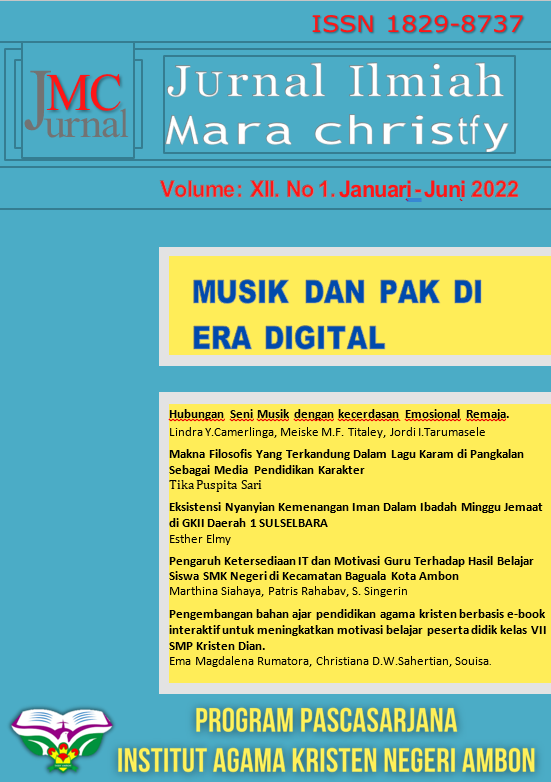
The existence of faith's victory song in the congregation's sunday service at GKII Regional I Sulselbara
DOI:
https://doi.org/10.37196/mc.v12i1.110Keywords:
Congregational Worship, Nyanyian Selamat Iman (NKI), GKII Region 1, Contemporary Worship, Musical DynamicsAbstract
The article investigates the evolution of Christian congregational worship, exploring the diverse musical landscape that includes psalms, hymns, and contemporary compositions. In the context of the Indonesian Gospel Tent Church (GKII), the "Nyanyayan Selamat Iman" (NKI), or "Victory of Faith Songs," stands out prominently, maintaining a significant role in Sunday worship. The study focuses on understanding the dynamics of NKI utilization within GKII Region 1, covering South Sulawesi and West Sulawesi. Specifically, it examines how NKI integrates into congregational worship practices amidst the rise of contemporary songs. Using a qualitative survey approach, the research delves into NKI's prevalence, significance, and contextual relevance in GKII Region 1. Data collection involves in-depth interviews with worship leaders and congregation members, along with an analysis of worship service recordings. Despite the influx of contemporary worship songs, the study uncovers a consistent demand for NKI within GKII's Region 1. Worship leaders and congregations stress the enduring spiritual and cultural significance of NKI in shaping the worship experience. The study concludes that NKI maintains a profound influence on GKII Region 1's worship practices, showcasing resilience amid changing musical preferences. Emphasizing the importance of preserving traditional hymns, the findings contribute valuable insights into the complex interplay between traditional hymns and contemporary worship songs in the Indonesian Christian context. The research serves as a foundation for future studies on the evolving landscape of religious musical practices.
References
N. Osborne and D. Grant-Smith, “In-Depth Interviewing,” in Methods in Urban Analysis, 2021, pp. 105–125. doi: 10.1007/978-981-16-1677-8_7
I. Ardhianto, “The End of Headhunting and the Globalizing Mission of Evangelical Christianity in Borneo,” in Hierarchies of Power: Evangelical Christianity and Adat Transformation in Indonesian Borneo, 2022, pp. 37–60. doi: 10.1007/978-981-19-0171-3_2
K. A. Steenbrink and J. S. Aritonang, “Chapter Eighteen. The Spectacular Growth Of The Third Stream: The Evangelicals And Pentecostals,” in A History of Christianity in Indonesia, BRILL, 2008, pp. 867–902. doi: 10.1163/ej.9789004170261.i-1004.203
M. Noll, “1899–1900: Ecumenism and Independency in the Emerging World History of Christianity,” in Ecumenism and Independency in World Christianity, BRILL, 2020, pp. 29–46. doi: 10.1163/9789004437548_004
J. D. W. Sim (???), “Making the South Seas a ‘Chinese’ Mission Field: Chinese Evangelical Missionaries to Southeast Asia, 1920s to 1950s,” Mission Stud., vol. 39, no. 3, pp. 304–330, Dec. 2022, doi: 10.1163/15733831-12341861.
K. A. Steenbrink and J. S. Aritonang, “Chapter Fifteen. A Small Christian Flock In Bali,” in A History of Christianity in Indonesia, BRILL, 2008, pp. 731–745. doi: 10.1163/ej.9789004170261.i-1004.184
A. S. Kanna, “Ulasan Buku Kisah kisah Misi Singkat di Berbagai Belahan Dunia,” J. Jaffray, vol. 16, no. 1, pp. 115–127, Mar. 2018, doi: 10.25278/jj71.v16i1.286.
D. Ronda, Kisah kisah Misi Singkat di Berbagai Belahan Dunia. Sekolah Tinggi Theologia Jaffray, 2018.
M. O. Emerson and K. C. Kim, “Multiracial Congregations: An Analysis of Their Development and a Typology,” J. Sci. Study Relig., vol. 42, no. 2, pp. 217–227, Jun. 2003, doi: 10.1111/1468-5906.00174.
W. H. Oliver, “From in-person to online worship,” Verbum Eccles., vol. 43, no. 1, p. 2404, May 2022, doi: 10.4102/ve.v43i1.2404.
W. J. & M. P. Reynolds, A Survey of Christian Hymnodi. Carol Stream: Hope Publishing Company, 1999.
S. N. Khan, “Qualitative Research Method - Phenomenology,” Asian Soc. Sci., vol. 10, no. 21, p. 298, Oct. 2014, doi: 10.5539/ass.v10n21p298.
M. Crang, “Qualitative methods: touchy, feely, look-see?,” Prog. Hum. Geogr., vol. 27, no. 4, pp. 494–504, Aug. 2003, doi: 10.1191/0309132503ph445pr.
M. Striepe, “Combining concept mapping with semi-structured interviews: adding another dimension to the research process,” Int. J. Res. Method Educ., vol. 44, no. 5, pp. 519–532, Oct. 2021, doi: 10.1080/1743727X.2020.1841746.
S. Elo, M. Kaariainen, O. Kanste, T. Polkki, K. Utriainen, and H. Kyngas, “Qualitative content analysis: A focus on trustworthiness,” SAGE Open, vol. 4, no. 1, p. 215824401452263, Jan. 2014, doi: 10.1177/2158244014522633.
N. L. Leech and A. J. Onwuegbuzie, “A typology of mixed methods research designs,” Qual. Quant., vol. 43, no. 2, pp. 265–275, Mar. 2009, doi: 10.1007/s11135-007-9105-3.
W. Bandara, E. Furtmueller, E. Gorbacheva, S. Miskon, and J. Beekhuyzen, “Achieving Rigor in Literature Reviews: Insights from Qualitative Data Analysis and Tool-Support,” Commun. Assoc. Inf. Syst., vol. 37, no. 8, 2015, doi: 10.17705/1CAIS.03708.
S. Imenda, “Is There a Conceptual Difference between Theoretical and Conceptual Frameworks?,” J. Soc. Sci., vol. 38, no. 2, pp. 185–195, Feb. 2014, doi: 10.1080/09718923.2014.11893249.
T. S. Rocco and M. S. Plakhotnik, “Literature Reviews, Conceptual Frameworks, and Theoretical Frameworks: Terms, Functions, and Distinctions,” Hum. Resour. Dev. Rev., vol. 8, no. 1, pp. 120–130, Mar. 2009, doi: 10.1177/1534484309332617.
Y. Qamar and T. A. Samad, “Human resource analytics: a review and bibliometric analysis,” Pers. Rev., vol. 51, no. 1, pp. 251–283, Mar. 2022, doi: 10.1108/PR-04-2020-0247.
Downloads
Published
Issue
Section
License
Copyright (c) 2022 Esther Elmy, Rev. Christopher Luthy

This work is licensed under a Creative Commons Attribution-ShareAlike 4.0 International License.


