
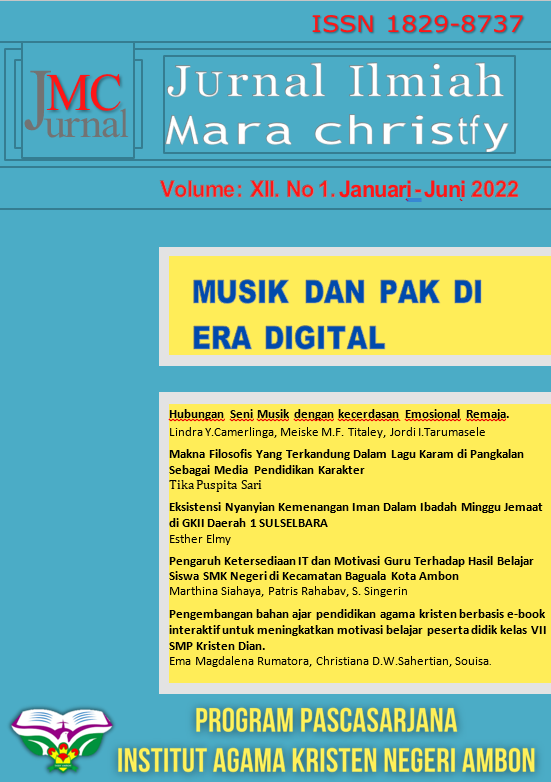
The relationship between musical arts and adolescent emotional intelligence
DOI:
https://doi.org/10.37196/mc.v12i1.111Keywords:
Music, Emotional Expression, Adolescents, Emotional intelligence, Correlation AnalysisAbstract
This study delves into the profound realm of the art of music, exploring its multifaceted nature involving the creation of sounds, melodies, and forms. These elements, permeating through singing, playing, and auditory experiences, become a medium for emotional expression deeply rooted within human beings. The realization of this expressive potential necessitates positive support from art enthusiasts, recognizing its profound impact on emotional maturity. Focusing on the impact of music on the emotional intelligence of adolescents, this paper adopts a comprehensive research approach. Employing the interview method and questionnaire surveys, the study gathers data from respondents, subsequently subjecting it to rigorous analysis using the correlation method approach. The findings indicate a compelling relationship between musical art (X) and adolescent emotional intelligence (Y). Correlation test results, with the calculated value (r count) surpassing the table value (0.6726 > 0.3120), highlight a statistically significant association. The t-test reinforces this conclusion, with a calculated t-value of 5.0631 exceeding the table value of 2.4285 (t count > t table). This robust statistical evidence strengthens the assertion of a positive and substantial relationship between musical art and adolescent emotional intelligence. In conclusion, this study contributes valuable insights by establishing a clear and quantifiable link between the art of music and the emotional intelligence of adolescents. The implications of this research extend to educational and developmental contexts, emphasizing the role of musical engagement in fostering emotional intelligence among the youth.
References
A. C. Petersen, N. Leffert, and B. L. Graham, “Adolescent Development and the Emergence of Sexuality,” Suicide Life-Threatening Behav., vol. 25, no. s1, pp. 4–17, Dec. 1995, doi: 10.1111/j.1943-278X.1995.tb00485.x.
M. Sarkova, M. Bacikova-Sleskova, A. Madarasova Geckova, Z. Katreniakova, W. van den Heuvel, and J. P. van Dijk, “Adolescents’ psychological well-being and self-esteem in the context of relationships at school,” Educ. Res., vol. 56, no. 4, pp. 367–378, Oct. 2014, doi: 10.1080/00131881.2014.965556.
R. J. Havighurst, “History of Developmental Psychology: Socialization and Personality Development through the Life Span,” in Life-Span Developmental Psychology, Elsevier, 1973, pp. 3–24. doi: 10.1016/B978-0-12-077150-9.50007-1
D. Goleman, Leadership: The power of emotional intelligence. More Than Sound LLC, 2021.
D. Groß, “In the self-control and self-regulation maze: Integration and importance,” Pers. Individ. Dif., vol. 175, p. 110728, Jun. 2021, doi: 10.1016/j.paid.2021.110728.
P. Gilbert, “Compassion: From Its Evolution to a Psychotherapy,” Frontiers in Psychology, vol. 11. p. 3123, 09-Dec-2020, doi: 10.3389/fpsyg.2020.586161.
T. Chamorro?Premuzic and A. Furnham, “Personality and music: Can traits explain how people use music in everyday life?,” Br. J. Psychol., vol. 98, no. 2, pp. 175–185, May 2007, doi: 10.1348/000712606X111177.
E. J. McGinnis, “Developing the Emotional Intelligence of Undergraduate Music Education Majors: An Exploratory Study Using Bradberry and Greaves’ (2009) Emotional Intelligence 2.0,” J. Music Teach. Educ., vol. 27, no. 2, pp. 11–22, Feb. 2018, doi: 10.1177/1057083717723919.
H. Chu and Q. Ke, “Research methods: What’s in the name?,” Libr. Inf. Sci. Res., vol. 39, no. 4, pp. 284–294, Oct. 2017, doi: 10.1016/j.lisr.2017.11.001.
J. Dewey, “Art as Experience,” in The Richness of Art Education, BRILL, 2008, pp. 33–48. doi: 10.1163/9789087906092_003
P. Simanullang, “Stigma Music of Human Life in Indonesia Orchestral Music,” PROMUSIKA, vol. 9, no. 2, pp. 94–100, Mar. 2022, doi: 10.24821/promusika.v9i2.5932.
T. Brunius, “The Uses of Works of Art,” J. Aesthet. Art Crit., vol. 22, no. 2, pp. 123–133, Jan. 1963, doi: 10.2307/427745.
R. S. Root-Bernstein, “The Sciences and Arts Share a Common Creative Aesthetic,” in The elusive synthesis: Aesthetics and science, 1996, pp. 49–82. doi: 10.1007/978-94-009-1786-6_3
R. Arya, “Contemplations of the Spiritual in Visual Art,” J. Study Spiritual., vol. 1, no. 1, pp. 76–93, May 2011, doi: 10.1558/jss.v1i1.76.
P. J. Silvia, “Emotional Responses to Art: From Collation and Arousal to Cognition and Emotion,” Rev. Gen. Psychol., vol. 9, no. 4, pp. 342–357, Dec. 2005, doi: 10.1037/1089-2680.9.4.342.
F. J. Sirois, “Aesthetic experience,” Int. J. Psychoanal., vol. 89, no. 1, pp. 127–142, Feb. 2008, doi: 10.1111/j.1745-8315.2007.00015.x.
A. Hamilton, “Music and the Aural Arts,” Br. J. Aesthet., vol. 47, no. 1, pp. 46–63, Jan. 2007, doi: 10.1093/aesthj/ayl038.
P. Alperson, “‘Musical Time’ and Music as an ‘Art of Time,’” J. Aesthet. Art Crit., vol. 38, no. 4, pp. 407–417, Jan. 1980, doi: 10.2307/430322.
J. K. Mendoza and C. M. Fausey, “Everyday music in infancy,” Dev. Sci., vol. 24, no. 6, p. e13122, Nov. 2021, doi: 10.1111/desc.13122.
A. Dewi, N. K. Bekti, and S. Supriyatiningsih, “Maternal Mortality Evaluation: A Case Study in Bantul, Yogyakarta,” J. Matern. Child Heal., vol. 4, no. 5, pp. 332–340, 2019, doi: 10.26911/thejmch.2019.04.05.07.
A. Maratos, C. Gold, X. Wang, and M. Crawford, “Music therapy for depression,” Cochrane Database of Systematic Reviews, vol. 1. 23-Jan-2008, doi: 10.1002/14651858.CD004517.pub2.
C.-Y. Yang et al., “The Effect of Music Therapy on Hospitalized Psychiatric Patients’ Anxiety, Finger Temperature, and Electroencephalography,” Biol. Res. Nurs., vol. 14, no. 2, pp. 197–206, Apr. 2012, doi: 10.1177/1099800411406258.
M. J. Crawford et al., “International multicentre randomised controlled trial of improvisational music therapy for children with autism spectrum disorder: TIME-A study,” Health Technol. Assess. (Rockv)., vol. 21, no. 59, pp. 1–40, Oct. 2017, doi: 10.3310/hta21590.
E. Labbé, N. Schmidt, J. Babin, and M. Pharr, “Coping with Stress: The Effectiveness of Different Types of Music,” Appl. Psychophysiol. Biofeedback, vol. 32, no. 3–4, pp. 163–168, Nov. 2007, doi: 10.1007/s10484-007-9043-9.
S. H. Saarikallio, W. M. Randall, and M. Baltazar, “Music Listening for Supporting Adolescents’ Sense of Agency in Daily Life,” Frontiers in Psychology, vol. 10. p. 2911, 08-Jan-2020, doi: 10.3389/fpsyg.2019.02911.
L. Chen, S. Zhou, and J. Bryant, “Temporal Changes in Mood Repair Through Music Consumption: Effects of Mood, Mood Salience, and Individual Differences,” Media Psychol., vol. 9, no. 3, pp. 695–713, May 2007, doi: 10.1080/15213260701283293.
F. Heinrich, “The aesthetics of interactive artifacts: thoughts on performative beauty,” in Proceedings of the 2nd international conference on Digital interactive media in entertainment and arts, 2007, pp. 58–64, doi: 10.1145/1306813.1306832.
C. L. Krumhansl, “Rhythm and pitch in music cognition,” Psychol. Bull., vol. 126, no. 1, pp. 159–179, 2000, doi: 10.1037/0033-2909.126.1.159.
J. G. Roederer, “Sound Vibrations, Pure Tones, and the Perception of Pitch,” in The Physics and Psychophysics of Music, New York, NY: Springer US, 2008, pp. 22–75. doi: 10.1007/978-0-387-09474-8_2
P. M. C. Harrison and M. T. Pearce, “Simultaneous consonance in music perception and composition.,” Psychol. Rev., vol. 127, no. 2, pp. 216–244, Mar. 2020, doi: 10.1037/rev0000169.
E. F. Clarke, “Rhythm and Timing in Music,” in The Psychology of Music, Elsevier, 1999, pp. 473–500. doi: 10.1016/B978-012213564-4/50014-7
P. Fraisse, “Rhythm and Tempo,” in Psychology of Music, Elsevier, 1982, pp. 149–180. doi: 10.1016/B978-0-12-213562-0.50010-3
T. J. Clark, “Clement Greenberg’s Theory of Art,” Crit. Inq., vol. 9, no. 1, pp. 139–156, Sep. 1982, doi: 10.1086/448192.
L. Perlovsky, “Musical emotions: Functions, origins, evolution,” Phys. Life Rev., vol. 7, no. 1, pp. 2–27, Mar. 2010, doi: 10.1016/j.plrev.2009.11.001.
C. L. Bell, “Toward a definition of a community choir,” Int. J. Community Music, vol. 1, no. 2, pp. 229–241, May 2008, doi: 10.1386/ijcm.1.2.229_1.
H. Gardner, “The theory of multiple intelligences,” Ann. Dyslexia, vol. 37, no. 1, pp. 19–35, Jan. 1987, doi: 10.1007/BF02648057.
E. J. Varon, “Alfred Binet’s concept of intelligence.,” Psychol. Rev., vol. 43, no. 1, pp. 32–58, 1936, doi: 10.1037/h0060709.
K. Lamb, “Raymond Bernard Cattell: A lifetime of achievement,” Mankind Q., vol. 38, no. 1, pp. 127–181, 1997, doi: 10.46469/mq.1997.38.1.8.
T. A. Salthouse, J. E. Pink, and E. M. Tucker-Drob, “Contextual analysis of fluid intelligence,” Intelligence, vol. 36, no. 5, pp. 464–486, Sep. 2008, doi: 10.1016/j.intell.2007.10.003.
D. L. Nelson and B. L. Simmons, “Health psychology and work stress: A more positive approach.,” in Handbook of occupational health psychology., Washington: American Psychological Association, 2003, pp. 97–119. doi: 10.1037/10474-005
M. Cabanac, “What is emotion?,” Behav. Processes, vol. 60, no. 2, pp. 69–83, Nov. 2002, doi: 10.1016/S0376-6357(02)00078-5.
R. L. Thorndike and S. Stein, “An evaluation of the attempts to measure social intelligence.,” Psychol. Bull., vol. 34, no. 5, pp. 275–285, May 1937, doi: 10.1037/h0053850.
D. Goleman, “The emotional intelligence of leaders,” Lead. to Lead., vol. 1998, no. 10, pp. 20–26, Sep. 1998, doi: 10.1002/ltl.40619981008.
J. D. Mayer, P. Salovey, and D. Caruso, “Models of Emotional Intelligence,” in Handbook of Intelligence, Cambridge University Press, 2000, pp. 396–420. doi: 10.1017/CBO9780511807947.019
R. Cooper and A. Sawaf, Executive Eq. Penguin, 1998.
J. D. Mayer and P. Salovey, Mayer-Salovery-Caruso emotional intelligence test. Multi-Health Systems Incorporated Toronto, 2007.
Downloads
Published
Issue
Section
License
Copyright (c) 2022 Lindra camerling, Meiske M.F. Titaley, Jordi I.Tarumasele

This work is licensed under a Creative Commons Attribution-ShareAlike 4.0 International License.


