
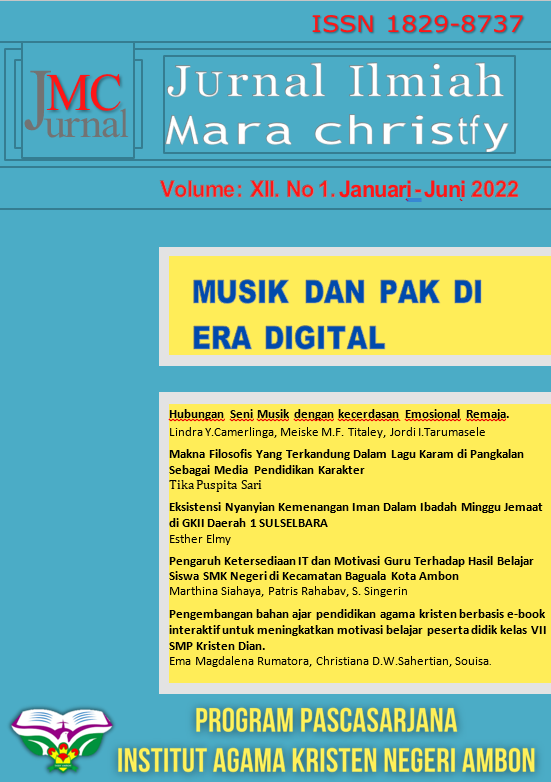
The influence of IT availability and teacher motivation on the learning outcomes of State Vocational School students in Baguala District, Ambon City
DOI:
https://doi.org/10.37196/mc.v12i1.112Keywords:
Digitalization 4.0, Information Technology (IT), Vocational Secondary Education, Teacher Motivation, Student Learning OutcomesAbstract
The article explores the impact of Digitalization 4.0 and the global pandemic on human civilization, emphasizing the pivotal role of Information Technology (IT) in Vocational Secondary Education. With a focus on State Vocational Schools in Baguala District, Ambon City, the study's objectives include describing IT availability, teacher motivation, and student learning outcomes, as well as investigating the individual and combined influences of IT availability and teacher motivation on student learning outcomes. Conducting research with 112 teachers from SMK Negeri 3 and SMK Negeri 6 Ambon, the study employs probability sampling, questionnaires, and documentation studies. Descriptive and inferential analyses reveal perceived low IT availability (50.90%, average value: 79.08), medium teacher motivation (48.21%, average value: 167.31), and good learning outcomes (69.64%, average value: 75.08). The t-test results demonstrate significant influences of IT availability (X1) (4.877, 17.80%) and teacher motivation (X2) (3.692, 11.00%) on student learning outcomes, with a substantial combined effect (27.10%). In conclusion, the research underscores the necessity of enhancing IT availability to foster competent vocational school graduates aligned with the demands of the digital era and evolving employment landscapes. The findings contribute to understanding the dynamic interplay between IT, teacher motivation, and student learning outcomes in the context of Vocational Secondary Education.
References
M. C. Tavares, G. Azevedo, and R. P. Marques, “The Challenges and Opportunities of Era 5.0 for a More Humanistic and Sustainable Society—A Literature Review,” Societies, vol. 12, no. 6, p. 149, Oct. 2022, doi: 10.3390/soc12060149.
Yoo, “Computing in Everyday Life: A Call for Research on Experiential Computing,” MIS Q., vol. 34, no. 2, pp. 213–231, 2010, doi: 10.2307/20721425.
C. Haythornthwaite, “Social networks and Internet connectivity effects,” Information, Commun. Soc., vol. 8, no. 2, pp. 125–147, Jun. 2005, doi: 10.1080/13691180500146185.
A. Grimes, C. Ren, and P. Stevens, “The need for speed: impacts of internet connectivity on firm productivity,” J. Product. Anal., vol. 37, no. 2, pp. 187–201, Apr. 2012, doi: 10.1007/s11123-011-0237-z.
H. Karar, “Algorithmic Capitalism and the Digital Divide in Sub-Saharan Africa,” J. Dev. Soc., vol. 35, no. 4, pp. 514–537, Dec. 2019, doi: 10.1177/0169796X19890758.
G. A. Barnett, B.-S. Chon, and D. Rosen, “The Structure of the Internet Flows in Cyberspace,” Netcom, vol. 15, no. 1, pp. 61–80, 2001, doi: 10.3406/netco.2001.1505.
M.-L. How, S.-M. Cheah, Y.-J. Chan, A. C. Khor, and E. M. P. Say, “Artificial Intelligence-Enhanced Decision Support for Informing Global Sustainable Development: A Human-Centric AI-Thinking Approach,” Information, vol. 11, no. 1, p. 39, Jan. 2020, doi: 10.3390/info11010039.
K. Dear, “Artificial Intelligence and Decision-Making,” RUSI J., vol. 164, no. 5–6, pp. 18–25, Sep. 2019, doi: 10.1080/03071847.2019.1693801.
Z. Ahmed, K. Mohamed, S. Zeeshan, and X. Dong, “Artificial intelligence with multi-functional machine learning platform development for better healthcare and precision medicine,” Database. 01-Jan-2020, doi: 10.1093/database/baaa010.
C. Naseeb, “AI and ML-Driving and Exponentiating Sustainable and Quantifiable Digital Transformation,” in 2020 IEEE 44th Annual Computers, Software, and Applications Conference (COMPSAC), 2020, pp. 316–321, doi: 10.1109/COMPSAC48688.2020.0-227.
M. R. Olfert and M. D. Partridge, “Best Practices in Twenty?First?Century Rural Development and Policy,” Growth Change, vol. 41, no. 2, pp. 147–164, Jun. 2010, doi: 10.1111/j.1468-2257.2010.00523.x.
G. Carrington and J. Stephenson, “The politics of energy scenarios: Are International Energy Agency and other conservative projections hampering the renewable energy transition?,” Energy Res. Soc. Sci., vol. 46, pp. 103–113, Dec. 2018, doi: 10.1016/j.erss.2018.07.011.
D. Gielen, F. Boshell, D. Saygin, M. D. Bazilian, N. Wagner, and R. Gorini, “The role of renewable energy in the global energy transformation,” Energy Strateg. Rev., vol. 24, pp. 38–50, Apr. 2019, doi: 10.1016/j.esr.2019.01.006.
S. Howell, Y. Rezgui, J.-L. Hippolyte, B. Jayan, and H. Li, “Towards the next generation of smart grids: Semantic and holonic multi-agent management of distributed energy resources,” Renew. Sustain. Energy Rev., vol. 77, pp. 193–214, Sep. 2017, doi: 10.1016/j.rser.2017.03.107.
W. L. Bennett, “he personalization of politics: Political identity, social media, and changing patterns of participation,” Ann. Am. Acad. Pol. Soc. Sci., vol. 644, no. 1, pp. 20–39, Nov. 2012, doi: 10.1177/0002716212451428.
P. Campbell, “Occupy, black lives matter and suspended mediation: Young people’s battles for recognition in/between digital and non-digital spaces,” YOUNG, vol. 26, no. 2, pp. 145–160, Apr. 2018, doi: 10.1177/1103308817713584.
S. E. Bibri, The Human Face of Ambient Intelligence, vol. 9. Paris: Atlantis Press, 2015. doi: 10.2991/978-94-6239-130-7
M. Barrett, E. Davidson, J. Prabhu, and S. L. Vargo, “Service Innovation in the Digital Age: Key Contributions and Future Directions,” MIS Q., vol. 39, no. 1, pp. 135–154, Jan. 2015, doi: 10.25300/MISQ/2015/39:1.03.
E. Ossiannilsson, “Visionary leadership for digital transformation: In a time when learners take ownership of their learning,” Asian J. Distance Educ., vol. 13, no. 1, pp. 128–148, 2018, doi: 10.4018/978-1-5225-2645-2.ch001.
S. Y. Ekanayake and J. Wishart, “Integrating mobile phones into teaching and learning: A case study of teacher training through professional development workshops,” Br. J. Educ. Technol., vol. 46, no. 1, pp. 173–189, Jan. 2015, doi: 10.1111/bjet.12131.
J. Hoyer, “Technology Integration in Education: The Dilemma of Shifting Paradigms,” Int. J. Learn. Annu. Rev., vol. 12, no. 6, pp. 1–8, 2006, doi: 10.18848/1447-9494/CGP/v12i06/45138.
P. J. Twomey and M. H. Kroll, “How to use linear regression and correlation in quantitative method comparison studies,” Int. J. Clin. Pract., vol. 62, no. 4, pp. 529–538, Mar. 2008, doi: 10.1111/j.1742-1241.2008.01709.x.
Downloads
Published
Issue
Section
License
Copyright (c) 2022 Marthina Siahaya, Patris Rahabav, S Singerin

This work is licensed under a Creative Commons Attribution-ShareAlike 4.0 International License.


